A restaurant kitchen can look busy and still be badly designed.
That is one of the most expensive illusions in foodservice.
You can have cooks moving fast, screens lighting up, printers firing, and servers shouting pickups—yet still lose margin every hour because the kitchen is not flowing well. Orders pile up at the wrong station. One bottleneck slows three others. Simple items get trapped behind complex ones. Staff work hard, but the system makes them slow.
That is why smart operators do not only ask, “How do I make the kitchen faster?” They ask, “How do I make the kitchen flow better?”
Because in real operations, speed without flow creates stress.
But flow creates throughput.
And throughput is what changes the economics of a restaurant.
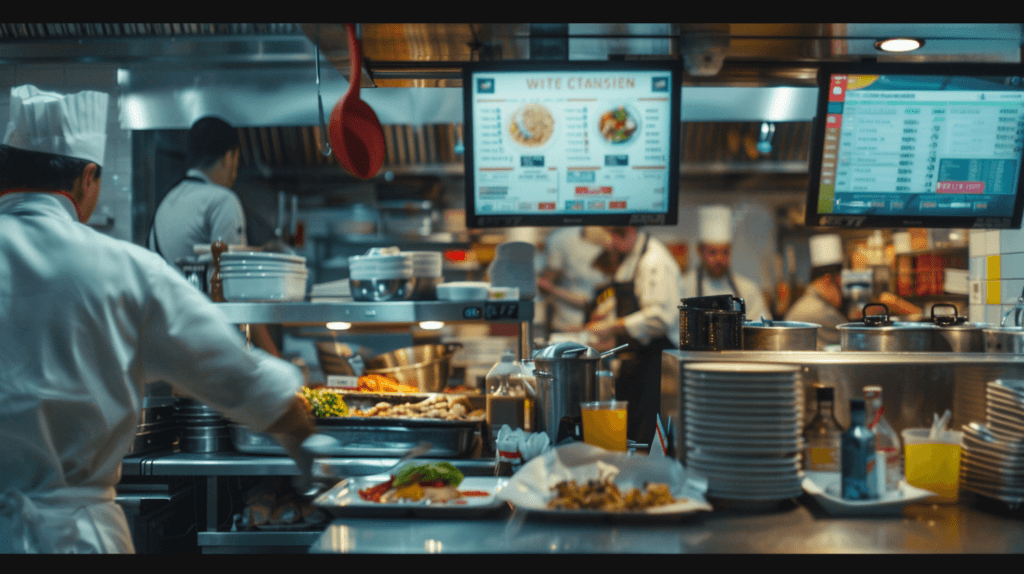
Modern restaurant systems now make this measurable. Kitchen display systems track ticket time from the moment an order is sent to the kitchen, and reporting tools can show tickets by hour, fulfillment times by station, and ticket-level detail—so kitchen flow is no longer just a feeling or chef intuition. It can be measured, diagnosed, and improved.
What kitchen flow optimization actually means
Kitchen flow optimization is the process of designing the back of house so that orders move through prep, cooking, assembly, expediting, and handoff with as little friction as possible.
That includes:
- station design
- order routing
- screen logic
- menu complexity
- staffing placement
- batch prep timing
- handoff between kitchen and front of house
- digital visibility into ticket status
A good flow system reduces wasted motion, reduces waiting between steps, and keeps the right work at the right station at the right time. Modern KDS platforms from providers like Square and Lightspeed are built around that exact idea: route orders to the right prep stations, track timers and statuses, and support separate prep, expo, and multi-station workflows.
Why speed matters less than throughput
A lot of operators obsess over “faster cooking.” That is only part of the picture.
The real goal is throughput: how many accurate orders your kitchen can complete during a rush without quality slipping, staff breaking down, or guests waiting too long.
That is why some kitchens feel fast in quiet periods but collapse at peak. They are optimized for individual effort, not for system capacity.
A high-throughput kitchen does five things well:
- routes work clearly
- separates bottlenecks from volume stations
- stages prep intelligently
- sequences orders properly
- gives the expediter real control
That logic shows up clearly in chain operations. Taco Bell’s Go Mobile 2.0 model includes a kitchen display system that lets staff prioritize orders by size and complexity, access build cards, and share orders across employees—a sign that major brands are no longer treating kitchen screens as passive displays, but as throughput tools.
The hidden cost of poor kitchen flow
When kitchen flow is weak, the damage is bigger than late food.
You usually get:
- longer ticket times
- more remakes
- weaker dine-in experience
- lower delivery reliability
- slower table turns
- worse labor productivity
- staff frustration and burnout
- lower sales during rush because the kitchen cannot absorb demand
The National Restaurant Association notes that kitchen automation can significantly improve efficiency, and specifically points operators toward digital kitchen display systems, task-guided kitchen displays, portion-control tools, and precision cooking technologies to improve speed and consistency.
The key word there is not “technology.” It is consistency.
Because a kitchen that performs well only when your best chef is on shift is not optimized. It is fragile.
The five biggest kitchen flow bottlenecks in SMB restaurants
1. One station is doing too much
This is common in small and medium restaurants. Grill handles dine-in, delivery, special requests, and last-minute modifications. Everything converges at one point. The whole line slows down.
2. Orders are visible, but not prioritized
A kitchen can see all orders and still work the wrong ones first. That is why timers, fire times, hold logic, and station-level views matter. Toast’s KDS documentation shows that kitchens can track ticket time from order send, and can separately manage fire times for paced or held courses.
3. Expo is weak or missing
Many SMB operators think expo is optional. During peak, it is not. Without a real expediter, cooks keep checking, front of house keeps interrupting, and plates leave incomplete.
4. Menu design fights the line
If your menu creates too many prep paths, too many exceptions, or too many long-cook items during peak, your kitchen is not under pressure because demand is high. It is under pressure because the menu is operationally heavy.
5. No one tracks station performance
If you cannot tell whether fry, grill, salad, or assembly is causing delay, you are managing blind. Toast’s kitchen reports explicitly break down fulfilled tickets by hour and by fulfillment time, including station-level views and ticket detail.
The practical operating model: how strong kitchens actually flow
The best kitchens usually follow a system that looks simple from the outside:
Order intake → station routing → prep execution → assembly/expo → handoff
But the strength is in the details.
Order intake must be clean
Every order source—counter, QR, POS, online ordering, delivery aggregator—should feed one source of truth. Lightspeed positions its KDS around exactly this: managing onsite and online orders from one digital source, with order status visibility at pass, production, and delivery stations.
Routing must match the physical kitchen
If your KDS routes well but your kitchen layout forces staff to cross paths constantly, you still lose time. Tech cannot fix a bad footprint on its own.
Prep must be separated from finish work
A strong kitchen does not start from scratch on every ticket. It stages intelligently, then finishes precisely.
Expo must own timing
Expo is not just a quality check. It is the flow controller.
Handoff must be clear
The final step is where many restaurants quietly lose seconds and accuracy—especially on delivery and pickup orders.
Square’s KDS highlights detailed ticket views, timers, alerts, station routing, and expeditor mode because that last stretch of the kitchen matters as much as the cook line itself.
Comparative analysis: paper tickets vs. KDS-driven kitchen flow
| Area | Paper ticket kitchen | KDS-driven kitchen |
|---|---|---|
| Order visibility | Fragmented, easy to miss | Centralized, live order view |
| Prioritization | Manual, often reactive | Timers, alerts, station views |
| Modifications/cancellations | Prone to delays and misreads | Real-time updates on screen |
| Multi-channel volume | Harder to manage cleanly | Better suited to dine-in, takeout, delivery |
| Expo control | Depends heavily on verbal communication | Better status tracking and sequencing |
| Reporting | Weak historical visibility | Ticket times, fulfillment times, station-level reporting |
| Scalability | Breaks under peak complexity | Better for structured rush handling |
This is the reason vendors and operators push KDS adoption so hard: it is not just paper replacement. It is process visibility. Lightspeed emphasizes real-time updates for modifications and cancellations, while Toast and Square emphasize timing, station logic, and fulfillment reporting.
Real industry examples operators should learn from
Taco Bell: prioritize complexity, not just sequence
Taco Bell’s Go Mobile 2.0 kitchen system allows staff to prioritize orders based on size and complexity, access build cards, and share orders among employees. That matters because the smartest kitchens do not treat every ticket the same. A four-item simple ticket and a heavily customized family order should not create the same line behavior.
Lesson for SMB restaurants:
Do not only process orders FIFO. Create a rush logic:
- simple fast tickets
- high-complexity tickets
- held/fired courses
- pickup-deadline orders
Sweetgreen: automation works when the line is designed around it
The National Restaurant Association highlights Sweetgreen’s Infinite Kitchen and notes the system can portion-dispense up to 500 salads per hour. It also cites reports that stores using the system saw improved order accuracy, lower labor turnover, and 10% higher ticket averages. Additional coverage reported the format could complete roughly 500 bowls per hour, and Sweetgreen discussed nearly 200 bowls in 30 minutes with 100% on-time reliability in one opening phase.
Lesson for SMB restaurants:
You do not need robots. But you do need to think like Sweetgreen:
- portioning must be repeatable
- assembly must be sequenced
- line design must support volume
- speed should not depend on memory
Chipotle: throughput is a culture, not only a layout issue
Industry reporting on Chipotle’s throughput focus shows the company measures performance in 15-minute increments and cares deeply about getting “the right people in the right places at the right time.” Reporting also notes initiatives like adding expediters and back-of-house equipment to improve throughput.
Lesson for SMB restaurants:
Kitchen flow is not just where equipment sits. It is also:
- who is placed where during peak
- when you add an expediter
- how you train for rush patterns
- whether staffing changes by daypart
How to optimize kitchen flow in a small or medium restaurant
Here is the part that matters most: what to actually do.
1. Map your kitchen like a process, not a room
Draw the path of an order:
- where it enters
- where it is first seen
- where each component is produced
- where it is assembled
- where it is checked
- where it exits
If team members cross each other repeatedly, double-handle items, or keep leaving station to ask questions, you have a flow problem.
2. Separate production stations by bottleneck, not category alone
Many kitchens divide stations traditionally: grill, fry, salad, dessert. That is fine until one category carries 70% of peak demand.
Instead ask:
- which station slows the line most often?
- which menu items collide at rush?
- where do customizations accumulate?
- where do late remakes usually start?
3. Install an actual expo workflow
If the kitchen is doing volume, somebody has to own:
- sequencing
- completeness
- pickup timing
- communication with FOH
- urgent reorder logic
A good expediter often adds more throughput than adding another cook blindly.
4. Use ticket-time data, not “rush felt bad” stories
Toast’s reporting allows operators to see average fulfillment time by hour, tickets by fulfillment time, and individual ticket detail. That means you can compare, for example:
- Friday 8–10 PM vs. Tuesday 8–10 PM
- prep station vs. expo station
- dine-in vs. online order pace
That is how you stop having vague meetings and start having useful ones.
5. Rewrite the menu where the line is suffering
If a menu item sells but destroys the line during rush, it may be hurting the restaurant more than it helps.
Questions to ask:
- Does this dish require extra handoffs?
- Does it create exception handling?
- Does it use bottleneck equipment?
- Can it be pre-prepped differently?
- Should it be restricted by daypart?
- Should it be removed from delivery?
6. Set peak-hour operating rules
During rush, not every item deserves the same treatment.
Use rules such as:
- fire cold and fast items immediately
- hold longer-cook items until capacity clears
- batch common components
- route large family orders separately
- create pickup-time priority for digital orders
That logic is exactly why modern KDS tools use timers, fire times, held items, status filters, and expeditor modes.
Food safety warning: faster kitchens still need control
This is where bad operators make a costly mistake. They hear “throughput” and start pushing speed in ways that damage food safety.
That is a serious risk.
The FDA’s HACCP framework is clear: food safety must be built around hazard analysis, critical control points, monitoring, corrective actions, verification, and documentation. The FDA also notes management commitment is essential for successful implementation.
So kitchen flow optimization should never mean:
- holding unsafe temperatures to save time
- batching beyond safe limits
- skipping checks during rush
- overloading hot holding without controls
The better approach is:
- use digital thermometers with logs and alerts
- standardize hold times
- build prep par levels around real demand
- use KDS and production cues to prevent panic cooking
The National Restaurant Association specifically points to digital thermometers that generate logs and alerts, plus precision cooking technologies, as useful automation tools for kitchen operations.
What SMB restaurants should implement first
Not every restaurant needs a giant redesign. Most need a better operating stack.
Best first upgrades
For dine-in casual restaurants
- one prep station KDS
- one expo screen
- station timers
- hourly ticket-time review
For fast casual
- order routing by station
- KDS with alerts
- simplified menu build paths
- expo ownership during peak
For delivery-heavy restaurants
- separate pickup/delivery sequencing
- dedicated handoff area
- online order prioritization logic
- cancellation/modification visibility in real time
For growing multi-branch SMB brands
- standard line layout
- same KDS logic across branches
- same rush rules
- same fulfillment KPI dashboard
KPIs that actually matter for kitchen flow
Most operators track too little or track the wrong thing.
You should watch:
- average ticket time
- 90th percentile ticket time
- fulfillment time by station
- remake rate
- expo delay rate
- ticket count by hour
- tickets delayed beyond target
- digital order on-time rate
- handoff-to-completion gap
- labor hours during peak vs. tickets completed
Toast’s kitchen reports already support the foundation for several of these: tickets by hour, average time to fulfill kitchen tickets, fulfillment time buckets, and ticket-level detail.
Real-life suggestions for restaurant owners
This is the practical part I would tell an actual operator.
If you run one branch
Stand in the kitchen for two full peak periods and do nothing except observe flow. Do not coach. Just mark:
- where people wait
- where they collide
- where they ask questions
- where they leave station
- where food sits ready but unserved
That alone will expose more than most weekly meetings.
If you run a delivery-heavy model
Stop mixing all channels the same way. A scheduled pickup order, a dine-in table, and a large aggregator order should not all move through the line with the same urgency.
If you run a menu with a lot of customizations
Use build cards, modifier discipline, and station-specific display logic. Taco Bell’s emphasis on build cards and prioritization is a useful model here.
If labor cost is tight
Do not immediately add headcount. First identify whether the issue is:
- poor layout
- poor sequencing
- bad menu design
- weak expo
- unclear order visibility
Very often, kitchens hire around a broken process instead of fixing it.
If you want the fastest operational win
Install a KDS and actually use the reporting weekly. Not just the screen—the data.
Conclusion
Kitchen flow optimization is not about making cooks move faster. It is about building a kitchen that can absorb demand cleanly, consistently, and profitably.
That is the difference between a kitchen that survives rush and one that monetizes rush.
The smartest restaurant operators in 2026 are designing kitchens around:
- visibility
- station logic
- sequencing
- ticket-time data
- expo control
- food safety discipline
That is how throughput improves.
And when throughput improves, everything else gets easier:
- ticket times
- guest satisfaction
- labor productivity
- order accuracy
- margin protection
In other words, kitchen flow is not a back-of-house issue.
It is a growth issue.
Worth exploring articles:
- Best POS Systems for Small Restaurants Under $50/Month (2026 Guide)
- How Restaurant Inventory Software Reduces Food Waste and Saves Costs
- AI Analytics for Restaurants: 7 Powerful Ways to Increase Profit in 2026
- AI Analytics for Restaurants: Turning Data Into Profitable Decisions (2026 Guide)
- AI for Small Restaurants: 7 Practical Ways to Increase Profit Without Big Budgets (2026)